

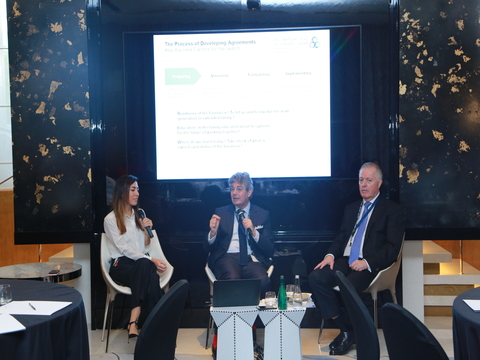
The Family Business Council-Gulf (FBCG), the regional association of Family Business Network International (FBN), hosted its 4th Annual Legal Roundtable to discuss how family businesses in the UAE and the GCC can develop a strong succession plan that ensures a smooth handover from one generation to the other.
Most family owned businesses in the UAE and the GCC are expected to face an ownership succession challenge within the next decade. As the family grows into its second and third generation, the need to prepare for the handover of control and ownership to the next generation becomes important.
Moreover, one of the most challenging tasks for families today is managing family dynamics, particularly when it comes to preparing the next generation, and managing family conflict. Based on research completed by FBCG, in collaboration with Mckinsey, only 32 percent believe they have clarity on the roles and responsibilities of family members in the family business. While this is a difficult topic to address given the sensitivities, organising such matters must be tackled head-on and made a priority, as it is one of the most important enablers for a successful generational transition.
FBCG’s Annual Legal Roundtable meeting is a platform for families to learn on best practices in family business governance and legal frameworks to aid in the structuring of family ownership rights.
Commenting on the role of FBCG in supporting family businesses through the continuity challenge, Chairman of FBCG, His Excellency Abdulaziz Al Ghurair, said: “We, at the Family Business Council, understand that without a well-planned and resilient governance and legal structure for a family business, the pursuit of continuity can be futile.” His Excellency Al Ghurair stressed that planning for succession and handover and instilling relevant family agreements is a crucial building block for an adequate preservation plan.
This year’s Legal Roundtable facilitated practical discussions on developing family constitutions and shareholding agreements. The sessions provided advice on the most effective processes for developing a common family vision and agreeing on the provisions of a family constitution; and discussed some of the common constitution provisions, such as: the recruitment and remuneration of the family members employed in the business, rules for the disclosure and exchange of information between family members (both employed and not employed by the family business), division of assets between the family members, and dividend policies. As the family grows, maintaining family commitment to a common vision and building a mutual understanding of the rights and responsibilities of all family members is key to its preservation and growth. A family constitution and formal shareholders’ agreements within the family business helps preserve family harmony in the future when transitioning the wealth and regulates relationships among the heirs for generations to come.
The closed door event was attended by representatives from families from the UAE and other GCC countries. Attendees engaged in a learning on the various elements that goes into a family constitution. Attendees also had a constructive discussion on challenges of development and reflected on best practices for tackling these challenges, while still considering each family business’ unique requirements and goals.
FBCG continues to address key topics related to the continuity of GCC family businesses through various activities including the Annual Legal Roundtable, the Annual Summit every April, education workshops, and other smaller knowledge sharing events.